Advertisements
Can you imagine identifying a nail, a coin, or even a buried fragment by simply sliding your phone over the ground and hearing a beep? It's real!
Don't close this guide: below you'll find the key steps to accurately calibrate, track, and interpret signals... your phone will be your best ally on every expedition!
Advertisements
From beginner to expert
Ready to take your detection skills beyond the basics? Well, get ready! In this final section, we'll fine-tune every detail and show you how to interpret signals with the accuracy of a professional prospector.
With advanced calibration steps, methodical exploration techniques, and responsible practices, your mobile detector will perform at its best. Forget false alarms and confusion: from now on, every beep will indicate something real and valuable… read on and conquer the terrain.
Advertisements
See also
- Play GTA Online for free on your mobile phone
- Discover the meaning of your dreams
- Connect with like-minded people without leaving your comfort zone
- Start your day with a sense-awakening infusion
- Discover your angel's name today!
Advanced calibration
Calibration is the key to distinguishing precious metals from mere junk. First, activate calibration mode and move your phone in a slow figure-eight motion for 10–15 seconds, away from cars or metal structures. This levels the virtual needle and reduces erratic readings.
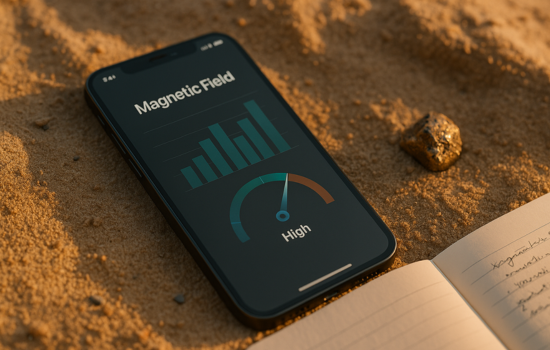
Next, adjust the minimum detection threshold: start at 5 µT to ignore weak interference and work your way up to 15–20 µT if you're looking for depth and valuable objects. Excessive noise? Activate "smoothing" or a moving average (1–2 s) to filter out momentary spikes and maintain a stable reading.
Don't forget to cross-check: pass the detector next to a known coin or key and check that it reacts within 0.5 seconds. If not, readjust the sensitivity. Repeat this calibration every 15–20 minutes or when changing areas: each environment has its own magnetic signature, and you'll need to adapt.
Exploration techniques
Exploring methodically increases your discoveries:
- Grid search: Divide the area into 1x1 m cells. Advance in horizontal passes, marking the strongest points with flags.
- Spiral pattern: Ideal for open areas; start in the center and expand in increasing circles to cover the entire area.
- Constant speed: Maintain a pace of 10–15 cm/s; going too fast causes false alarms, and going too slow wastes time.
- Interpretation of signsA sharp, rapid spike is usually iron; a soft, sustained signal indicates non-ferrous metals. Adjust the threshold based on the signal's amplitude and duration.
- GPS logIf your app allows it, geotag each find and create heat maps. This way, you can plan future expeditions and optimize routes.
With these methods, you'll maximize the performance of your mobile detector and make your searches more efficient... and fun!
Responsibility and good practices
Having fun isn't at odds with ethics. Before exploring, ask the landowner for permission: exploring without permission can cause conflict.
In historic or protected areas, avoid digging; contact authorities or archaeologists if you think you've found something valuable. If your detector indicates ammunition remains or dangerous objects, mark the area and notify emergency services for safe removal.
When sharing your findings online, please omit exact coordinates to protect the sites and prevent looting. And please fill in any gaps you make: caring for the environment is part of the hobby.
Share your discovery
Was this guide helpful? Share it with your crew of explorers! Send the link via WhatsApp, Telegram, or social media and help more adventurers find metals with their phones. Leave your comments with photos, general directions, and experiences: your contribution will enrich the community.