Advertisements
Are you ready to start your journey in the world of karate? Learn martial arts in the comfort of your home is now possible thanks to this detailed guide. Here, you'll discover how the karate It can be more than a form of combat, becoming a discipline that integrates philosophy and personal development.


Our guide is specifically designed for beginners with no prior experience in martial artsWith dedication and constant practice, you will be able to develop effective skills of karate from home. In the following sections, we will explore the benefits of karate for the body and mind, and we will provide you with the necessary knowledge to start your experience in this martial art.
Get ready to embark on a journey of self-discovery and personal improvement through art of the karate, thus enriching your life daily.
Advertisements
The Basics of Karate for Beginners
Karate is a discipline that goes beyond physical combat, focusing on peace of mind and self-control. To an inexperienced observer, it may seem like a martial art all about showy displays of violence; however, it's quite the opposite. Karate is about peace and, more importantly, peace of mind.
The Philosophy and Principles of Karate
The philosophy of karate is deeply rooted in principles such as discipline, respect, and perseverance. These principles not only guide the physical practice of karate but also influence the daily lives of its practitioners. By adopting these principles, you can experience a positive transformation in your approach to life's challenges.
Advertisements
Some of the key principles include:
- Discipline: Fundamental for progress in karate.
- Respect: Towards oneself, instructors and classmates.
- Perseverance: Overcoming obstacles and continually improving.
See also
- Learn Karate by Fighting at Home: A Beginner's Guide
- 5 best apps to watch free TV on your mobile device
- PLAY DOMINO ONLINE WITH APPS: The best domino app
- Boost Your Energy with Vigor Boosting App
- Learn Zumba at home with our experts.
Benefits of Practicing Karate at Home
Practicing karate at home offers a number of benefits, from flexible scheduling to financial savings. By eliminating barriers such as travel or initial shyness, you can focus effectively on your personal and physical development.
Specific benefits include:
- Improved cardiovascular fitness and flexibility.
- Stress reduction and improved concentration.
- Increased confidence and promotion of positive values.
In short, karate is a holistic practice that offers both physical and mental benefits. By taking up this discipline, you can experience a significant improvement in your quality of life.
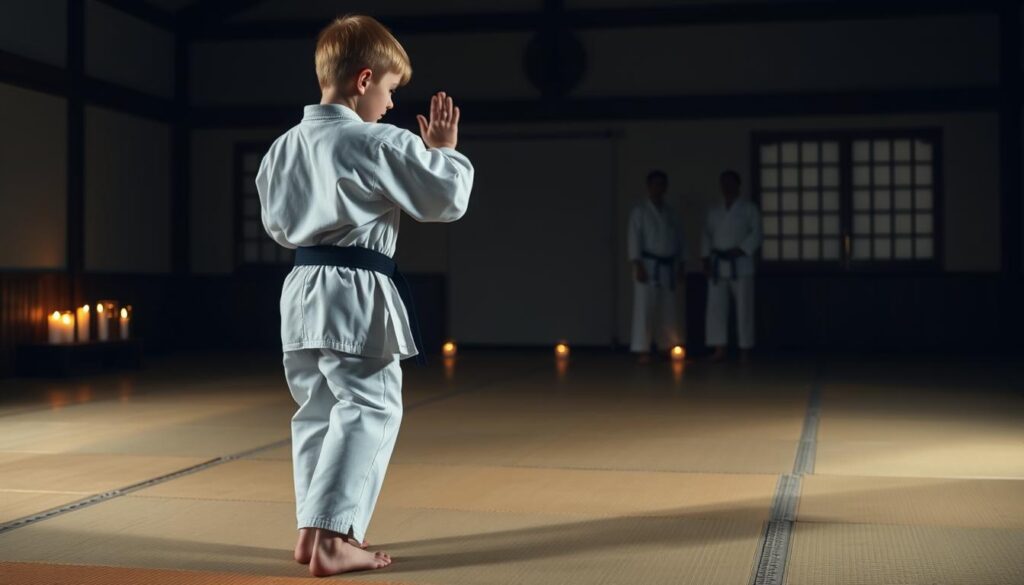
Preparation for LEARN KARATE FIGHTING AT HOME
Before beginning your karate journey, it's crucial to prepare your environment and your mindset. Proper preparation will allow you to get the most out of your training sessions and minimize the risk of injury.
Creating a Suitable Training Space
To train karate at home effectively, you need adequate space. Find an area with enough room to move freely, without obstacles or distractions. Make sure the floor is flat and non-slip to avoid accidents. A mirror can be helpful for checking your stances and techniques.
Basic Equipment Needed for Beginners
Basic equipment for practicing karate at home includes a tatami mat or mat to protect your joints during floor exercises. A stopwatch or timer will help you maintain a consistent pace during your workouts. Although not essential, a punching bag or training dummy can be helpful for practicing striking techniques.
Warm-up and Meditation Routine
A proper warm-up and meditation routine is essential before beginning any karate session. Start with a five-minute meditation, focusing on your breathing and clearing your mind of distractions. Then, warm up with a plank that includes running in place, push-ups, sit-ups, leg lifts, and reverse planks. “Mental and physical preparation is the key to effective training.”A good warm-up routine will help you increase your energy and focus.
Remember that meditation and warm-up should be adapted to the time and mode of training that you have planned. By increasing your energy and physical preparation, you will be able to make the most of your karate sessions at home.
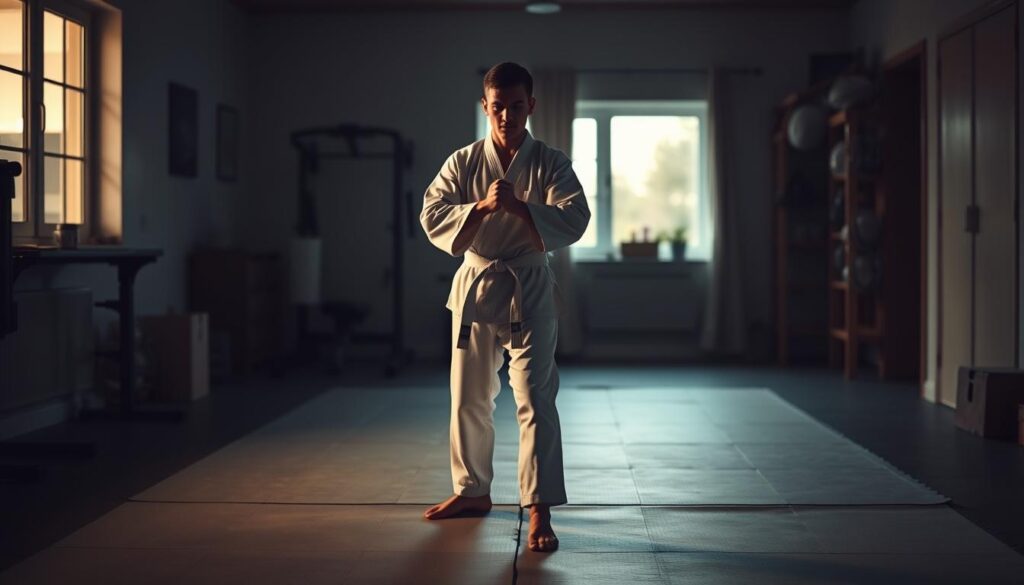
Basic Karate Techniques to Practice at Home
In this section, we'll introduce you to the basic karate techniques you should know to practice effectively at home. These techniques will allow you to improve your skills and progress in this martial art.
Fundamental Positions (Dachi)
The fundamental stances in karate are essential for maintaining balance and generating power in your movements. Some of the most common stances include the standing stance (Fudo-dachi), the horseman stance (Kiba-dachi), and the cat stance (Nekoashi-dachi).
Punching and Blocking Techniques (Tsuki and Uke)
Punching and blocking techniques are crucial in karate. The punch (tsuki) is used for striking, while the block (uke) is used for defense. Some of the most common punching techniques include the front punch (seikenzuki) and the side punch (yokozuki).
Basic Kicks (Geri)
The basic kicks in karate include the front kick (Mae-geri), the side kick (Yoko-geri), the roundhouse kick (Mawashi-geri), the back kick (Ushiro-geri), and the crescent kick (Mikazuki-geri). To execute these kicks effectively, it is important to generate power through proper rotation of the hip.
There are five basic karate kicks you should know:
| Kick | Description |
|---|---|
| Mae-geri | Quick front kick, raising your leg in front of you. |
| Yoko-geri | Side kick, lifting the leg to the side. |
| Mawashi-geri | Roundhouse kick, rotating the leg in a circle. |
| Ushiro-geri | Back kick, kicking in the opposite direction to the one you are facing. |
| Mikazuki-geri | Half-moon kick, raising the leg in a semicircular motion. |
To improve the speed and precision After your kicks, it's important to practice progressive exercises that develop your balance, flexibility, and strength. You can find more information on how to practice karate at home in our article. Learn Karate Quickly.
Workout Routines for Beginners
Developing an effective training routine is crucial to improving your karate skills. By establishing a regular practice, you'll be able to progress steadily and safely.
15-Minute Daily Workout
Start with short, 15-minute sessions a day. This will help you maintain consistency without feeling overwhelmed. The key is regularity, not in duration. You can start with basic warm-up exercises, followed by karate techniques, and ending with stretching.
Progression of Techniques and Combinations
As you move forward, it is important incorporate new techniques and combinations to your routine. Practice different stances (dachi), punching and blocking techniques (tsuki and uke), and kicks (geri). Gradual progression will allow you to improve your skill and confidence.
Kata Practice to Improve Form
The practice of kata is fundamental in karate. Practice the kata over and over again, focusing on one in particular each session. Once you've mastered it, move on to another. Kata like Heian Shodan or Taikyoku Shodan are ideal for beginners. Remember to pay attention to posture, breathing, and rhythm.
By following these training routines, you'll be able to effectively improve your karate skills. Constant practice and dedication are key to your progress. Remember that each training session is an opportunity to improve and perfect your techniques.
Conclusion
When you start your journey in the karate, it is essential to remember that constant practice is key to progress. Throughout this guide, you have learned the basic fundamentals and techniques for practicing karate at home.
It is important to note that the karate It's a martial art that requires patience and dedication. The principles and techniques learned not only improve your fighting skills but also provide benefits in other areas of your life.
To continue improving, we encourage you to complement your learning with additional resources such as videos and books. Seeking the guidance of a qualified instructor will eventually help you correct mistakes and advance your practice. Share your experiences and progress on your learning journey. karate.