Advertisements
Getting started with embroidery doesn't require an expensive course or a room full of materials. With a phone, a simple hoop, and a willingness to try, you can start stitching today, without technical hassles or impulse purchases.
Apps turn your phone into a mini-workshop: clear videos, short exercises, and progress logs. You learn slowly, repeat just the right amount, and see real progress without getting lost in random online tutorials.
Advertisements
The goal at the beginning is not to “be an expert”, it is finish something small That makes you smile: an initial, a flower, a patch. That early victory ignites motivation and brings you back tomorrow.
Here we talk in simple terms: which materials to buy first, how to read a pattern without stress, which stitches to prioritize, how to avoid tension mistakes, and how to create a kind habit that sustains your projects.
Advertisements
See also
- Vitality Tea: Gentle Energy in a Cup
- Learn to play guitar with apps
- How to download and play GTA: San Andreas on mobile
- Apps for selling and buying used items
- Apps for inspection and maintenance
Why learning with apps works without killing the manual charm
Embroidery is rhythm, gesture, and patience. An app helps order the way: shows stitches in short clips, suggests small goals, and reminds you to practice. The useful thing is the immediate feedback: It tells you if you're over-tightening, if the needle angle is awkward, or if the stitch is loose. It also prevents "zapping syndrome" (a thousand half-baked techniques): it suggests a sensible sequence of outlines, simple fills, and small textures so you can move forward without getting overwhelmed. If you're feeling creative, there are apps to draw your motifs on your phone, import them from photos, and turn them into guides. If you ever switch to a typewriter, there are also options that send designs to compatible devices via Wi-Fi, keeping the creative flow in one place.
Your first kit that performs (without overspending)
You don't need a whole haberdashery. Start with frame medium (firm tension, without “bumping” the fabric), needles of two thicknesses, fabrics clear cotton for practice and mouliné thread (cotton) in three colors and one neutral. Add scissors small and sharp for clean finishes. To transfer designs, use textile pencil or water-soluble marker; leave the permanent markers for later. Keep everything in a pencil case. visible- What's at hand, happens. When you want to play, add little by little: metallic needles, a new palette, or a larger frame. Avoid large purchases at the beginning; the best upgrade is practice.
Stitches that pay off fast: outline, fill, and texture
Start with backstitch for crisp contours and cornering control: teaches rhythm without demanding strength. Adds chain stitch when you want a soft embossed edge or bold lettering. For fills, the satin looks even if you respect the direction and length of each stroke; practice on small sheets. For texture, the French knot Create points of light and volume; start with a few turns to avoid tangles. Golden rule: choose two stitches per week and repeat them in mini-projects. Finishing something small is more valuable than collecting techniques you don't use.
Reading a pattern on your mobile (without getting lost)
Think of the pattern as map: lines for outline, areas for fill, dots for texture. Use zoom to toggle detail and compositionIf the app allows layers, leave only the one you'll be working on today active. Mark what you've done with a color or star; avoid redoing due to confusion. When importing an image, simplify: Fewer lines, basic shading, and defined spaces. In hand embroidery, less information means more control. The finish depends more on your rhythm than on a busy graphic.
First project that is finished (and makes you come back)
Choose one initial or a sheet. Draw with textile pencil, thread a short strand (avoid knots), secure the hoop. Backstitch around the edges, fill in small areas with satin stitch, and add two or three French knots as accents. Remove before and after photo: Comparing sparks motivation. If the fabric puckers, loosen the tension or lengthen the stitch a little. Finish neatly on the back: a good finish makes the work last in the wash and encourages you to give them as gifts.
Common mistakes and easy solutions
The classic is the excessive tension: wrinkles the fabric and tires your hand. Antidote: lower the pressure, breathe, and distribute the filling in several gentle strokes. Another is change stitches every five minutes; decide on a mini-goal (“complete outline” or “fill in this sheet”) and accomplish it before trying anything else. Skipping the auction It's tempting: learn two punchlines and repeat them all the time. Posture and light Important: loose shoulders, side lighting, eye breaks every 10 minutes. And don't forget record progressA photo per session is worth a thousand tips; seeing progress sustains the habit.
Habit that sticks: mini-ritual and visible goals
While you prepare the table, install your mini-ritual: breathe 4-4-6 (inhale 4, hold 4, exhale 6), shake shoulders and set a goal minimum 10–15 minutes. If you still want to, keep going; if not, you've already won. Leave the case in plain sight and put reminders Soft. Two short sessions a day are more effective than a Sunday marathon. If you're stuck, change only one Variable: stitch, thread, or motif size. This measurable variation keeps you curious without distracting you.
Designing from your mobile: from sketch to fabric (and then to machine)
Whenever you want create your motifs, use an app with layers, brushes, and export to a guide. Draw vector or freehand, import a photo, trace outlines, and define fill areas with the final stitch in mind. cross stitch, choose apps that square the image and allow you mark progress box by box; they are perfect for long projects without getting lost. If you take the leap to machineThere are official apps that send designs via Wi-Fi to compatible devices, with stitch catalogs and fine-tuning adjustments. This sketch-edit-embroider flow saves you time and eliminates cables.
When is it a good idea to ask for help or join a community?
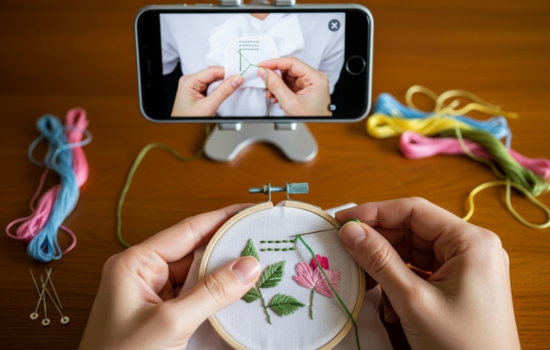
If a technique resists even satin on curved edges, French knot that comes apart, chain stitch on curves a short session With a teacher, you can correct in minutes what would take weeks. It also helps to share progress in communities: comments on angle, strain and auctions are worth their weight in gold. Record yourself from above for a minute: sometimes you'll discover that the problem was overtighten either enter crookedlyThe goal is to return to enjoyment; the technical aspects are accommodated with small adjustments.
Closing: your first piece today, the following ones tomorrow
The embroidery does not run: it enjoyWith a clear app, a basic kit, and small goals, you can finish an initial or a flower today. Tomorrow, repeat; in a week, you'll have a piece that makes you smile. Short, sweet consistency, not perfectionism, is what turns a hobby into a habit.
Download the apps
Embroidery App: Stitch Design — Step-by-Step Stitch Guide (Android)
• Google Play (Android): Google Play
Creative Embroidery Designs 3D — Lessons and Patterns (iOS)
• App Store (iOS): Apple