Advertisements
Starting out on the guitar doesn't require expensive equipment or an impossible schedule. With your phone and a basic acoustic guitar, you can progress today, at your own pace, without feeling alone or overwhelmed.


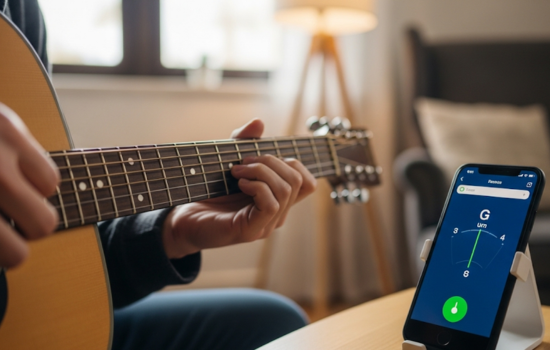
The best apps listen to what you play through the microphone and give you immediate feedbackThey alert you if the chord sounds “stifled,” if the strum falls off-time, or if the change is late.
The key is not to practice hours: it is practice well and oftenTen or fifteen minutes a day, with clear goals, can overcome a Sunday marathon. Consistency turns rhythm into reflex and handwriting into memory.
Advertisements
Here we talk without jargon. You'll learn how to set up your environment, structure micro-habits, choose simple songs, and avoid mistakes that rob you of energy. The goal is to play cleanly, even if it's slow; speed comes on its own.
Advertisements
Why learning with apps works (and doesn't distract you from what's important)
An app doesn't replace a great teacher, but democratizes What helps most at the beginning: order, clear exercises, and real-time correction. The microphone detects fretwork; metronome It teaches you how to count; short videos clarify posture and strumming without going around in circles. Plus, they gamify just enough: streaks, daily goals, and easy songs to celebrate. early victory keeps motivation high.
The learning path that pays off begins with basic chords (Em, G, C, D), slow changes, simple patterns, and first songs with two or three chords. It adds tools you'll use all the time: tuner, chord dictionary and backing tracks to play along with. Golden rule: practice slow and clean; speeding up is a reward, not a shortcut.
Prepare your setup in 5 minutes: tuning, posture and sound
Before playing, tune alwaysA low string ruins any progress. Place your left hand near the fret to use less force; if it hurts, stop and adjust. The right hand strums from the forearm, with a loose wrist; a stiff wrist sounds harsh and tiring.
Space also helps. A rug or curtains reduce echo and let you hear the chord details. If steel strings bother you, try lighter gauges and shorter, more frequent sessions. And keep your phone handy with a metronome and tuner open; reducing friction helps you practice more.
14-Day Plan: Micro-Habits That Spark Progress
Days 1–3: posture, intonation, and two basic chords. Practice the change for 60–90 seconds per round, with short breaks.
Days 4–6: add a simple strumming pattern and play over a clue slow. Goal: stability, not speed.
Day 7: active rest: tune, strum gently and stretch your hands.
Days 8–10: add a third chord and use the metronome. Start slow, go up little by little when it sounds clean.
Days 11–13: Choose a 2–3 chord song and play it at a reduced tempo every day.
Day 14: Record yourself and compare yourself to day 1. Seeing the change in audio or video gives more fuel than any advice.
Two extra tricks: “phantom shifts” (you form the chord in the air and hit it) and count out loud (“down-up”) to set the beat.
Rhythm and strumming: let the metronome be your ally, not your judge
The metronome is not a punishment: it is a buddy that shows you where to fall. Start with a low tempo and look for two perfect bars; then speed it up a bit. Alternate "clicking on quarter notes" with "clicking on two and four" to internalize the groove. Try palm mute (gently place your palm on the bridge) to control the noise between changes. If you lose your pulse, don't chase after it: stop, breathe and re-enter on the next lap.
Clean-sounding chords: economy of movement
The guitar rewards the economy. Anticipate the next chord by moving your fingers “in the air” during the last strum; this way the change lands on time. Keep your fingers arched so you don’t drown out neighboring strings and rest near the fret to reduce the force. If the capo (barbell), build strength with two- or three-string mini-bars, without struggling with full form on day one. After each block, shake hands for 10 seconds: micro-pauses prevent tension that slows down the habit.
Songs of the first month: choose with your heart, not with fashion
Motivates what do you like itThe initial repertoire should have two or three chords and a simple pattern. Play the same song every day for a week; when you get it right, change the pattern or pick up the tempo. Alternate "technical" days with "musical" days: if it's all exercise, your mind gets saturated. And allow for small "versions" of your own: a different strumming, a slower intro. That personal touch keeps you coming back tomorrow.
Common Mistakes (and the Practical Antidote)
Run ahead of time. When you accelerate, the buzzing and muted strings return. Antidote: slow down, correct posture, and resume slowly.
To overtighten. It hurts and sounds worse. Look for it. minimum pressure with finger glued to the fret.
Collect exercises. Ten half-baked things, zero songs. Short cut: two chords + one pattern + one song.
Tense posture. Shoulders up, wrist stiff. Readjust every 5 minutes; release and resume.
Skipping breaks. The hand needs micro-breaks to build a sustainable routine.
Comparing yourself to years compressed into 60 seconds. Compare yourself to yourself from 7 days ago: is the measure that pushes.
Stay motivated: measure, share, and vary one at a time
Record your sessions in the app and define tiny goals“30 seconds of non-stop GC,” “playing X at 70% tempo.” At the end of the week, listen to the original version and your recording; that comparison fuels your desire.
Sharing a short audio with friends every two weeks creates pressure positiveIf you're stuck, change. a variable: pattern, tone or song. When the app proposes challenges or streaks, use them to establish the habit (two weeks in a row is worth gold). Motivation is not “found”; it is builds with evidence of progress.
When to add extra classes or equipment?
If the app gives you the same error over and over again, a one-off session with a teacher unlocks in minutes what would only take weeks. You don't need to buy a thousand things: a guitar that tune well, comfortable capo and pick that feels natural. A medium To leave the guitar visible doubles the practice: what's at hand, happens. If you later want a remote or interface to record yourself, let it be for serve your practice, not to postpone it.
Closing: Play clean today, play better tomorrow
Your measure of success is not playing fast, it's playing clearSpeed comes from a short, frequent routine, with chords that fall in time, and songs that move you. The app organizes, you repeat without rushing. If you follow this approach, in a month you'll be surprised to hear how "musical" what feels mechanical today sounds. That's the game.
Recommended apps (iOS and Android):
Justin Guitar: Lessons & Songs – Apple / Google Play
Simply Guitar (JoyTunes) Apple / Google Play
Yousician Apple / Google Play